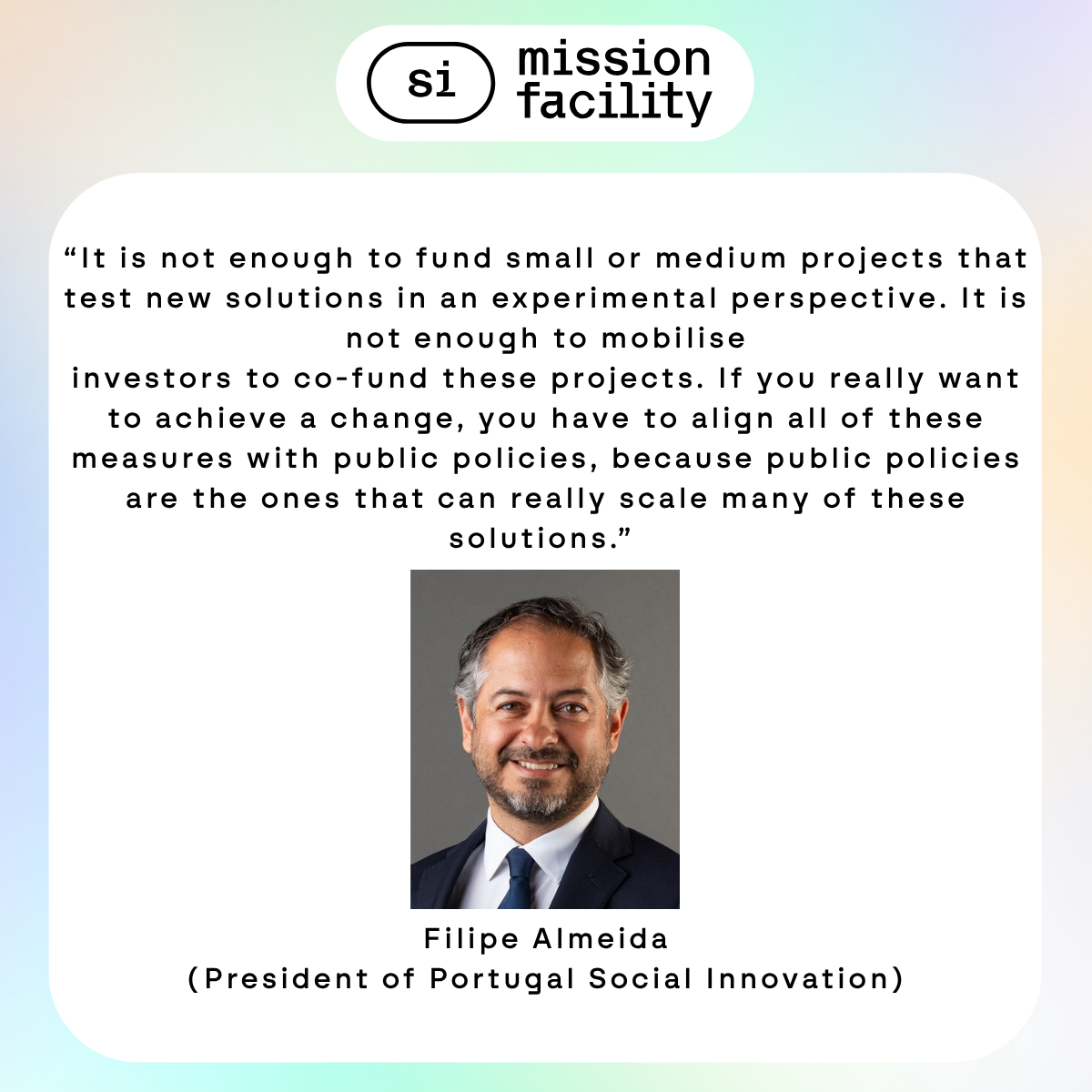
On 29 April, 2025, the SIMF spoke with Filipe Almeida, President of Portugal Social Innovation, about social innovation and current developments on EU level policy.
Introducing Filipe Almeida

Filipe Almeida is the President of Portugal Social Innovation, which is the national public policy initiative dedicated to social innovation within the Portuguese government.
Portugal Social Innovation was established to both promote social innovation and develop a robust social investment ecosystem. We primarily use European Structural Funds – currently the European Social Fund Plus – to finance innovative projects addressing pressing societal challenges. A key feature of our model is that we match public funding with social investment, fostering cross-sector collaboration and building new alliances across stakeholders.
Over time, Portugal Social Innovation has become a central hub within the national ecosystem, connecting social entrepreneurs, investors, public authorities, academia, and civil society organisations. It is not only a funding mechanism, but also a coordinating platform embedded at the core of government, with a clear mandate to drive systemic change.
How does your work connect to social innovation?
Portugal Social Innovation was created in 2014 as a pioneering, government-led initiative. From the outset, it played a catalytic role in shaping the national social innovation ecosystem.
Our work connects to social innovation (SI) in three fundamental ways:
First, we experiment with financial instruments and support projects that test new solutions to social challenges across sectors.
Moreover, we are building bridges and actively facilitate collaboration and co-creation between investors and different forms of organisations.
And thirdly, as a public agency, we further ensure that promising solutions are connected to public administration, enabling pathways to scale through policy integration.
Specifically, the last point is crucial. We believe that social innovation cannot remain at the level of isolated experimentation and if we want real transformation, solutions must be embedded into public policies, which remain the most effective vehicle for scaling impact.
What added value does social innovation bring to mission-oriented policy and to addressing major societal challenges?
Mission-oriented policies aim to tackle complex, systemic challenges such as climate change, inequalities, or public health. Traditionally, these policies rely on top-down, technical approaches. Social innovation adds a fundamentally different dimension to this.
It introduces a bottom-up, human-centred, and systemic perspective, with several key contributions:
Social innovation enables active participation, as it brings citizens, communities, and grassroots actors into the design and implementation of solutions.
Through active participation, solutions can be better aligned with real needs as solutions are shaped by those directly affected, making them more relevant and effective.
Mission-oriented initiatives become more effective when people affected by the problem are actively involved in shaping solutions. Trust can be built through the participation and empowerment of the people affected, and stronger relationships between institutions and communities can result from participatory processes.
With this understanding social innovation encourages tailored, context-specific solutions rather than one-size-fits-all approaches and thus also entails a preventive element as root causes can be addressed rather than merely compensating for symptoms.
Ultimately, SI can also bring together actors from different sectors to co-create solutions.
In essence, social innovation enriches mission-oriented policy by making it more inclusive, adaptive, and transformative.
Why does social innovation still struggle to receive adequate policy attention and funding support?
There are several structural and conceptual barriers.
First, social innovation remains misunderstood. It is often conflated with traditional social policy focused on compensation rather than transformation. This limits its perceived scope and ambition.
Second, it does not fit into existing policy silos. Social innovation is inherently cross-sectoral, while public administration, and EU funding structures, are still largely compartmentalised.
Third, technological innovation continues to dominate the narrative. Innovation is still widely equated with technology, whereas social innovation is often seen as secondary, despite being an end in itself.
In addition, with regards to funding challenges, impact of social innovations is difficult to measure, making it riskier for funders and policymakers. In alignment with the rather fragmented ecosystem, advocacy remains weak, with actors often operating within their own “bubble.” These combined factors prevent social innovation from becoming mainstream in policy and funding frameworks.
What are the current gaps in funding or support for social innovation on EU level?
In my perspective, several gaps in funding support persist on EU level:
There is a fragmented funding landscape, and social innovation is spread across multiple programmes, limiting coherence and visibility. Especially the reliance on ESF+ funding ties social innovation primarily to employment and social inclusion, leaving areas like climate, digitalisation, and community resilience underexplored.
EU level support for social innovation is currently paired with heavy administrative burden. Small organisations and startups often lack the capacity to navigate complex funding requirements. In addition, while experimentation is funded (usually in the form of new projects developed), there are few mechanisms to support the scaling of successful solutions, especially through public policy integration and programmes rarely assess how projects influence public policy evolution.
Lastly, match-funding mechanisms on EU level remain underexplored and there are limited instruments that effectively combine public funds with private or social investment.
Addressing these gaps is essential to move from isolated innovation to systemic change.
How should social innovation be reflected in the next EU Multiannual Financial Framework (MFF 2028–2034)?
A major step forward has already been taken in 2014 by requiring all Member States to include social innovation as an investment priority. This should not only be maintained but strengthened.
Looking ahead, several improvements are needed from Filipe Almeida’s perspective:
- Maintain mandatory inclusion of social innovation: Removing this requirement would be a step backwards.
- Increase visibility: Introduce clearly labelled budget lines for social innovation, rather than dispersing funding across programmes.
- Improve coordination: Avoid fragmentation across regions and instruments.
- Simplify access: Introduce micro-grants and fast-track funding for smaller organisations.
- Support different development stages: Create multi-stage funding pathways from early experimentation to mature scaling.
- Promote blended finance: Combine grants with instruments such as social impact bonds and equity-based funding.
- Fund organisations, not just projects: Provide core funding to strengthen organisational capacity and resilience.
- Strengthen impact measurement: impact evaluation enables comparability across projects.
- Invest in capacity building: Support not only innovators but also public authorities, academia, investors, and media.
These changes would significantly enhance the effectiveness and reach of social innovation in Europe.
What concrete changes would you like to see in future EU programmes and policy instruments?
If we want social innovation to truly deliver systemic impact, EU programmes should shift from funding experimentation alone to funding scaling pathways, particularly through public policy integration.
To achieve this, cross-sector alignment should be strengthened and silos between social, environmental, and economic policy areas should be broken down.
EU programmes must also reduce administrative complexity, which is especially relevant for smaller actors. Strengthening blended finance and match-funding models and leveraging private capital is another recommendation which could also potentially help with reducing administrative complexity.
Impact measurement also needs to become more systematic. At the same time, organisations need support to build the capacities required to measure and communicate impact effectively.
Ultimately, Filipe stresses that the goal should be to move from a fragmented ecosystem of projects to a coherent system where social innovation informs and transforms public policy at scale.
Portugal Social Innovation demonstrates how a coordinated, government-led approach can catalyse an entire ecosystem. Yet, as Filipe Almeida highlights, the real challenge lies not in generating innovative ideas, but in embedding them into systems. For the next EU funding cycle, the question is no longer whether to support social innovation, but how to ensure it drives lasting structural change.