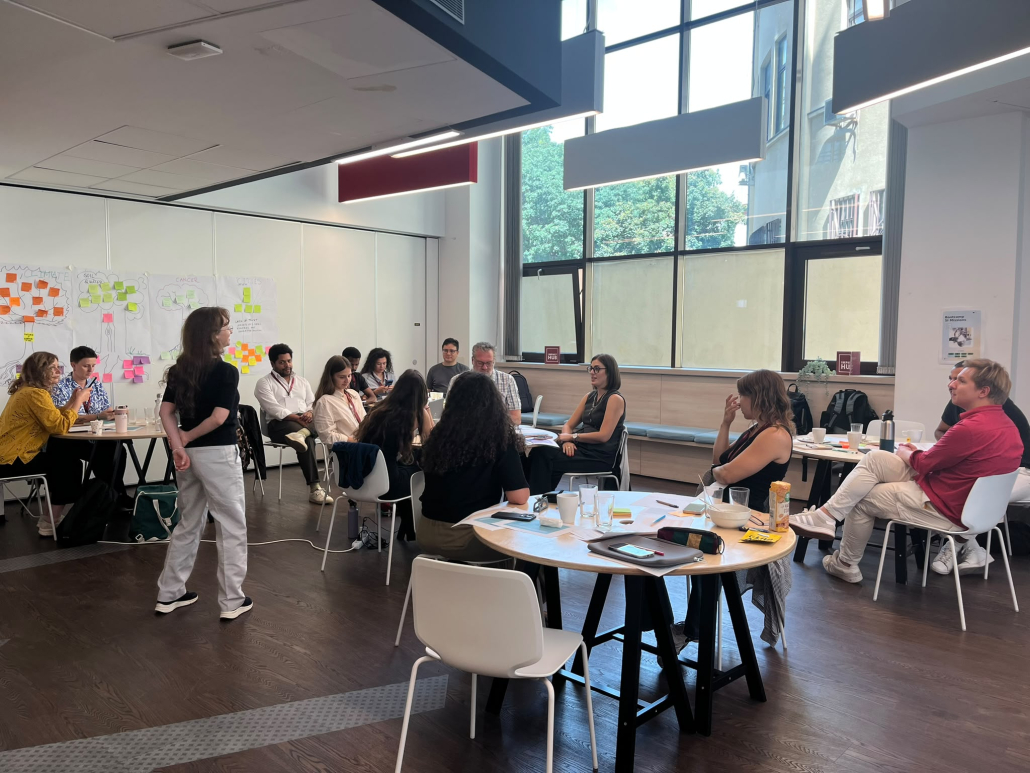
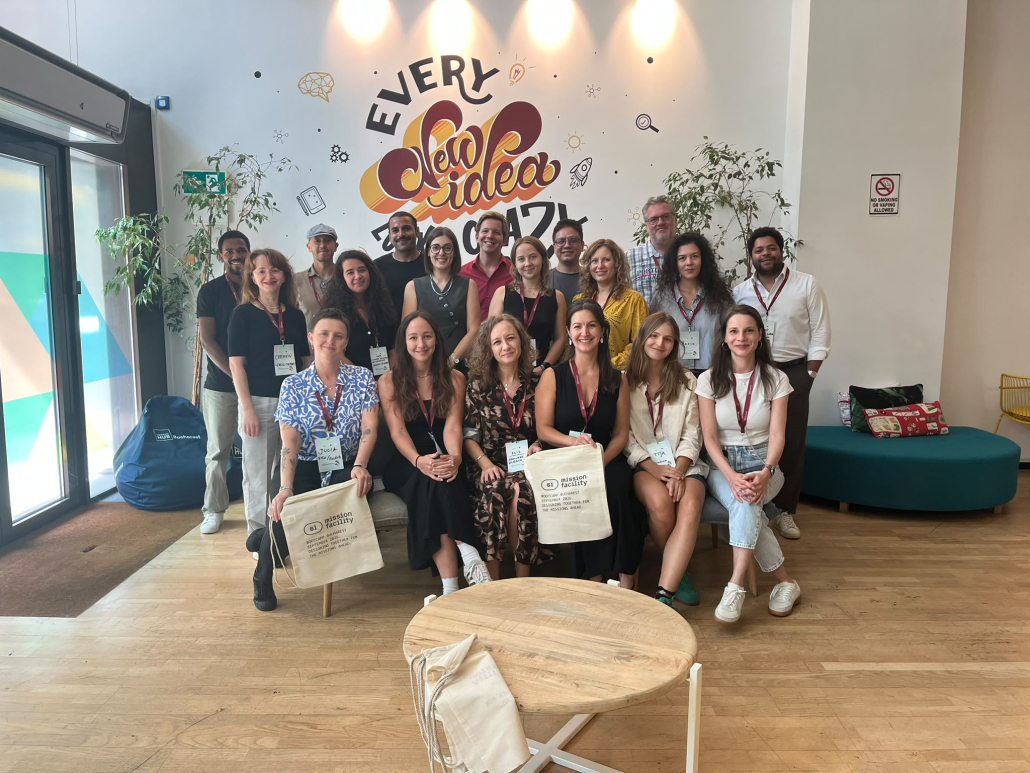
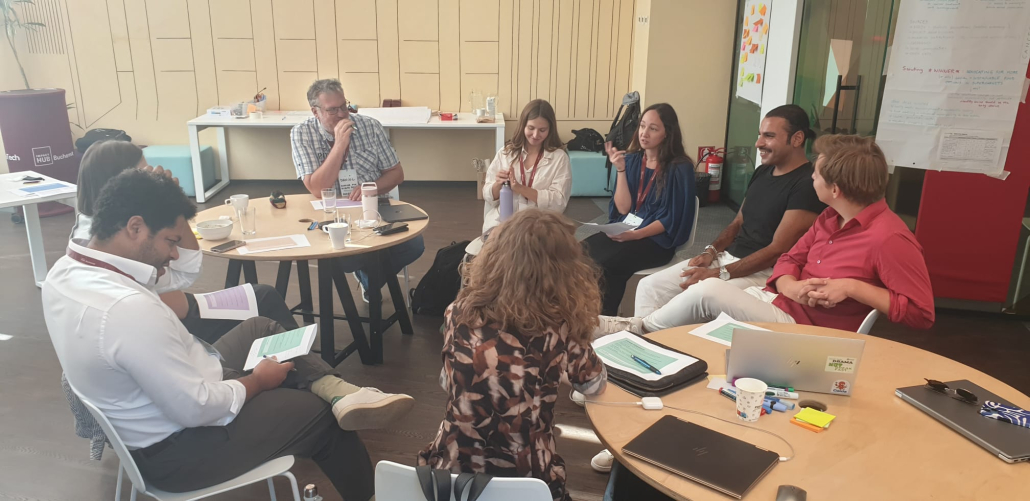
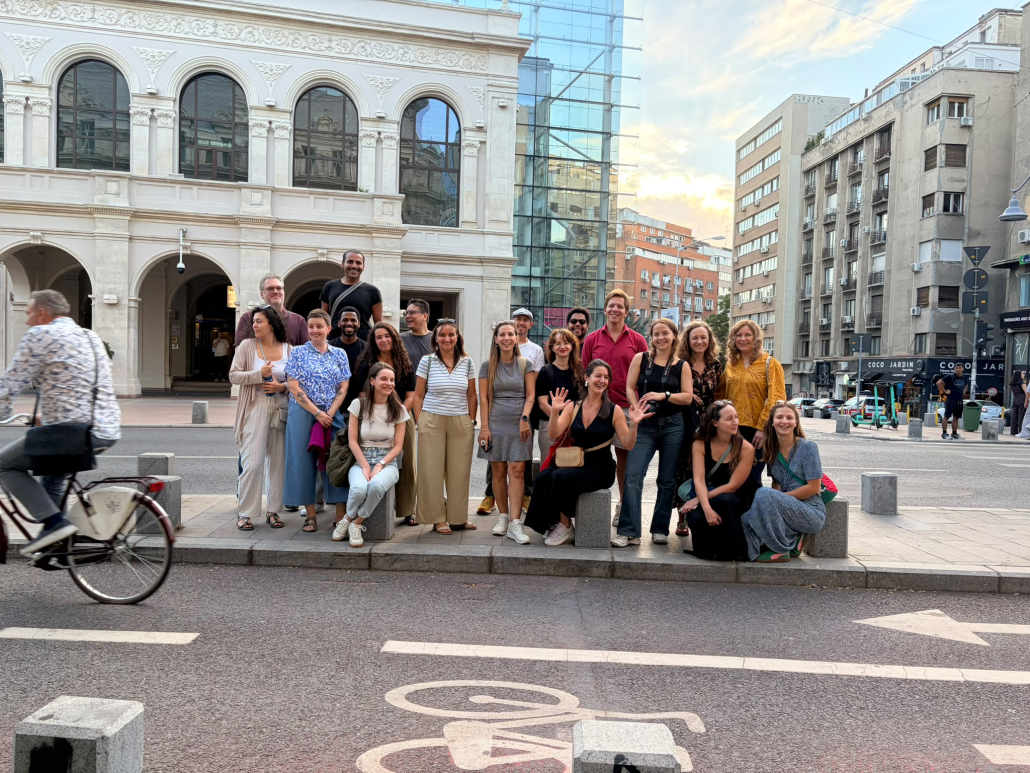
From 7–9 September, Impact Hub Bucharest hosted the SI-Mission-Facility Cross-Mission Bootcamp
— bringing together 15 changemakers from support organisations across 13 countries, all working on the EU Missions for Cancer, Climate-Neutral Cities, Climate Adaptation, Soil Health, and Ocean & Waters.
Over three days, the group moved from big-picture thinking to concrete action: mapping the challenges behind each Mission, learning how to spot and support the right social innovations, practising facilitation as a tool for change, and testing ways to measure real impact. On Day 2, participants worked through programme design and scaling strategies, exploring how solutions can grow through replication, policy change, culture shift, or being adopted by mainstream institutions.
The bootcamp closed with each participant developing a personal 90-day action plan and an accountability partner, turning three days of learning into next steps for their organisations.
A huge thank you to our facilitators, speakers, and every participant who brought their experience, questions, and energy into the room. This is just the beginning of a growing European community of practice around Mission-driven social innovation.
See, what selected participants said about the Bootcamp
[What was most useful is] the networking, knowing that we don’t have to do these missions alone, and with the support we have, we can support innovators effectively.
The networking, knowing that we don’t have to do these missions alone, and with the support we have, we can support innovators effectively.
Stay tuned — more from the SI-Mission-Facility network coming in soon.
The SIMF has published Deliverable 1.2 on the Catalogue of SI Impact Pathways.
This catalogue explores and makes visible the ways in which social innovation (SI) contributes to the current five EU Missions and to mission -oriented innovation policy (MOIP) more broadly. It does so through two analyses. It examines how SI is currently embedded within the Mission s programming cycle and draw s on emerging insights to suggest how it can be more strongly integrated to fully leverage its transformative potential. It also traces how SI s — characterised by new practices, social relations, organisational forms, and institutional arrangements that address societal challenges in new ways — contribute to Mission objectives and goals via their actual or potential outcomes in society, in what we refer to as SI impact pathway.
The SIMF Social Investment Lab will bring together a carefully selected group of around 30 impact investors, philanthropists, policymakers, entrepreneurs and ecosystem leaders in Lisbon (15–16 October 2026) to explore financing models that bridge the gap between grant funding and impact investment.
While the SIMF Social Investment Lab is an invitation-only event, we want to broaden the conversation and create an opportunity for additional voices to join us.
If you work in social investment, impact investing, philanthropy, public policy, social entrepreneurship, or social innovation, and feel your experience could contribute to the discussions, we encourage you to submit an Expression of Interest.
📍 Lisbon, Portugal 📅 15–16 October 2026
The Social Investment Lab (15 October 9:00 – 16 October 14:00)
The Social Investment Lab explores financing models that support social innovation – specifically the underserved space between grant funding and impact investment finance, where many social innovations struggle to find the capital to scale.
Over two days, 30 people – a deliberately small group of impact investors, philanthropists, policy makers, entrepreneurs and others – will examine models already working elsewhere and stress-test ideas in a European context.
This is the first of three Labs. The goal is a set of financial framework agreements that funders, investors and the European Commission would, in principle, be glad to work through together: a blended capital stack designed to support social innovation.
The RoundTable (16 October, 14:30-19:00)
This roundtable is a high-level European strategic conversation bringing together funders, investors, philanthropic organisations, policymakers, ecosystem actors and social innovation leaders to explore how Europe can strengthen its financing architecture for mission-oriented social innovation. The event will be followed by networking drinks.
Interested? Please submit your Expression of Interest as soon as possible.
As places are limited, participation cannot be guaranteed. Selected applicants will be informed by mid-September whether they have been offered a place.
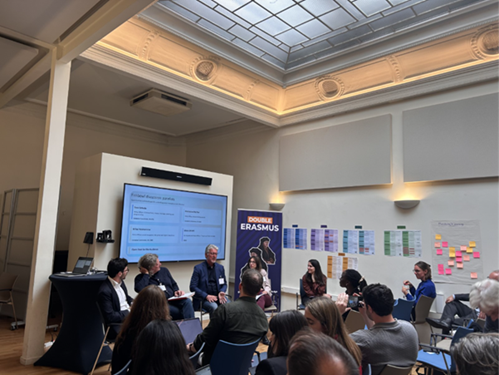
In May 2026, EdelGive/SIX convened the first gathering of our Funder and Impact Investor Social Innovation Mission Facility Exploration, in Brussels. This account of the evening shares what we’re still sitting with, and an invitation to what comes next.
The conversation began with a question about money itself.
What is it for? Who does it serve? And what happens when the instrument we are trying to use to fund social change is – by its own internal logic – oriented toward something else entirely (spoiler alert, capital accumulation by a few and not equitable or regenerative outcomes)?
That was the provocation that opened our convening at Commons Hub Brussels, hosted with characteristic warmth and generosity by Leen Schelfhout. And it turned out to be a good starting place for our exploration.
Why Brussels? Why May 2026?
EdelGive/SIX is part of the Social Innovation Mission Facility – a European consortium working to explore how social innovation can be more effectively sourced, encouraged and financed within the framework of EU Missions. Those Missions – climate adaptation, cancer prevention, soil health, ocean restoration, climate-neutral cities – require both technical innovation, and social innovation. The social innovation that builds trust, shifts behaviour, coordinates systems, and enables communities to adopt new approaches over the long term.
Social innovation rarely fits a conventional funding model. It tends to be relational, place-based, and slow to mature. It generates public value rather than private enterprise value. And yet we keep asking it to prove itself on terms designed for something different.
The question we brought to Brussels was simple to state and hard to answer: can we redesign the capital stack so it actually fits the work?
The panel
Three practitioners brought the conversation to life, each from a distinct vantage point.
Anne Snick opened by asking us to do something most finance conversations rarely do: look at the money system itself. She offered the image of money as a pharmakon – the Greek word for a substance that can be either medicine or poison, depending on how it is used. When money flows toward what serves us, it is generative, medicinal. When the accumulation of money becomes the goal itself, it can turn into poison. Her provocation was direct: is it possible to fund social change using instruments structurally oriented toward extraction? Do we have to innovate the money system, not just the products within it?
Luisa Bernardes from Portugal Social Innovation brought the practitioner’s view – including the honest account of what hasn’t worked. Portugal has built a rich portfolio of financing instruments: capacity building, grant-based partnerships, social impact bonds. What remains missing, she argued, is an equity-like instrument for projects that deserve patient co-investment – a model that treats the funder as a genuine patient investor willing to co-create value. Despite a few attempts, they’ve not yet designed a financial instrument that institutions want to be part of, that works over the longer term and with concessional or below market returns.
Pieter-Jan Van de Velde from Trividend and the European Catalytic Impact Investing Fund II offered what might be the sharpest structural analysis of the evening. He described a capital market with a conspicuous gap: enormous amounts of capital at the philanthropic end (minus 100% financial return in finance language) and interest if there are market-rate return expectations of +15% – but almost nothing in between. The organisations doing the most important mission-critical work often sit precisely in that gap, the -100% to +15% space. They create real value. They just cannot capture it in ways the current system recognises. His challenge to governments was pointed: stop requiring private sector matching as a condition of public investment. That mechanism grows the market without broadening it. It finances what the market already wants to finance, rather than what the market cannot reach.
The audience brought the conversation further still. Where are the citizens in all of this? What does it mean that we call communities “beneficiaries” when they are the ones doing the work? How do democratic accountability pressures make long-horizon thinking structurally difficult for governments? And can we design participatory mechanisms – local citizens’ assemblies, peer-led funding pools – that give communities genuine influence over where money flows?
A reflection from beyond the room
Amir Rizwan had been due to join the panel. A last-minute conflict prevented him from attending – but his thinking arrived ahead of him, and it deserves its own space here, because it shifted the frame of the entire conversation.
Amir’s argument was not that we need more money. Globally, there is no shortage of liquidity. The issue is whether capital is structured around the actual work of mission adoption and societal transition.
He named what he sees as the central structural gap: we ask mission-enabling organisations to behave like investable businesses before the ecosystem around them has made that possible. They are expected to evidence demand, de-risk adoption, and show revenue pathways – while simultaneously doing the civic and relational work that markets rarely reward directly. That double burden is not a design flaw that patient capital alone can fix. It reflects something deeper: the assumptions of mainstream finance – growth, liquidity, institutional risk, return expectations – have been imported wholesale into social investment, even when the organisations receiving that investment are doing something fundamentally different.
Drawing on Mariana Mazzucato’s argument that public institutions must shape and co-create markets rather than simply correct market failures, and on Carlota Perez’s work on how major societal transitions require institutional redesign alongside innovation, Amir pushed toward a more structural ask. The question is not only “how do we deploy capital more ethically?” It is “what would it mean to redistribute influence over capital, ownership, learning, and institutional direction?”
If he had been in the room, that question would have taken the conversation somewhere even more uncomfortable. We intend to go there in the upcoming labs we are planning as part of this project.
What we are still sitting with
Several tensions from Brussels do not yet have resolution, and we are not going to pretend they do.
The pharmakon tension. Anne Snick’s framing invites us to interrogate the money system at a level most finance conversations do not reach. But the people trying to fund social innovation cannot simply wait for the money system to transform itself. What is the relationship between working within existing instruments and advocating for new ones – and where does pragmatism tip into complicity?
The SIB debate. Social impact bonds provoked real disagreement. For some in the room they represent a useful mechanism for bringing private capital into public problem-solving. For others, they privatise the risk of innovation, require near-certainty of outcomes before investment, and reproduce the very dynamic they claim to disrupt. We do not think this is settled. It deserves a proper lab of its own.
The “simplify or innovate” dilemma. One honest observation from the room: social innovators are already bamboozled by the complexity of existing finance. Adding new instruments risks making things worse, not better. But as Pieter-Jan noted, simplification often means homogenisation – and homogenisation tends to squeeze out the innovators who most need something different. What does well-designed complexity look like, and who bears the translation cost?
The citizen question. Several voices noted that funders, investors, and policymakers were doing all the talking. Communities and citizens were largely absent from the room and, more importantly, from the instruments being designed. If participatory governance correlates with mission-aligned investment – which emerging research suggests – then this is not a values point. It is a design principle.
What comes next – and an invitation
This convening was the opening move, not the conclusion. Over the coming years, EdelGive/SIX will be facilitating three labs and a roundtable as part of this network’s ongoing work, each designed to go deeper into a specific aspect of how patient capital can be integrated into the capital stack alongside philanthropic, public, and market-rate finance.
We are actively looking for funders, impact investors, foundation professionals, and social innovation practitioners who want to be part of this work – not as observers, but as co-designers. The labs are designed for people who are genuinely grappling with these questions in their own practice and are willing to bring that honestly into the room.
If Brussels taught us anything, it is that the field does not lack intelligence or goodwill. What it sometimes lacks is the space and structure to work through the hard questions without rushing to resolution. That is what we are trying to create.
If you would like to be involved, get in touch: sojung.rim@socialinnovationexchange.org
And if you were in Brussels and want to continue the conversation – or if you were not in Brussels but recognise your own questions in what you have read here – we would love to hear from you.
With thanks to Anne Snick, Luisa Bernardes, Pieter-Jan Van de Velde, Amir Rizwan, Leen Schelfhout and Commons Hub Brussels, and everyone who brought their thinking to the room.
https://staging.simissionfacility.eu/wp-content/uploads/2025/09/SIMF-BASICS-LOGO-V1-RGB_SIMF-BASICS-LOGO-V1-POS-RGB.svg00Leonie Dworskyhttps://staging.simissionfacility.eu/wp-content/uploads/2025/09/SIMF-BASICS-LOGO-V1-RGB_SIMF-BASICS-LOGO-V1-POS-RGB.svgLeonie Dworsky2026-07-05 10:55:012026-07-05 10:56:20Reflections from the Brussels SI Mission Facility Exploration – how to finance social innovation
Are you a social innovator or social entrepreneur working on topics like climate, health, waters/oceans, cities, or food and soil?
Your work may already be part of something bigger: Europe’s five EU Missions.
Join the SI-Mission-Facility Training & Scaling Programme, a European capacity-building journey for social innovators and social entrepreneurs working on solutions connected to the EU Missions: climate adaptation, cancer, oceans and waters, climate-neutral and smart cities, and soil and food systems.
The programme combines EU-wide webinars, mission-focused learning, national in-person meetings and regional practical sessions delivered by the Impact Hub Network together with mission-focused Impact Hubs across Europe.
Through the programme, you will explore where your initiative fits within the EU Missions, strengthen your scaling readiness, learn from experts and peers, and prepare for future opportunities – including the later SI-Mission-Facility Competition of scaling SIs* (*The Scaling Competition will open early in 2027 through a separate application and selection process).
Participation in the SI-Mission-Facility capacity-building activities is open to social innovators and social entrepreneurs from EU Member States and Horizon Europe Associated Countries. These activities are designed to inform, prepare and identify promising mission-relevant social innovations. Social innovators interested in the later competition will be invited to complete an expression of interest or apply once the competition call opens in 2027.
*Read more about the mission related expertise of the Mission Hubs below in FAQ.
your benefits
What every participant gains (open to everyone who registers)
Understand where your innovation fits within the EU missions context Learn how your work can contribute to one or more of the five EU Missions: Climate Adaptation, Cancer, Oceans and Waters, Climate-Neutral and Smart Cities, and Soil, and Food Systems.
Access and apply practical tools for scaling social innovation Use frameworks, reflection tools and guidance designed to help social innovators clarify their mission fit, scaling potential, impact logic, and support needs.
Learn from mission-focused experts and ecosystem practitioners Take part in EU-wide and regional sessions with Impact Hub teams, mission-focused partners, support organisations and invited practitioners.
Connect with a European community of social innovators Meet peers working on similar challenges across Europe, exchange experiences and identify opportunities for collaboration.
Get better prepared for the future Scaling Competition Participants interested in the later competition will be able to use the programme to clarify their scaling needs and prepare for the future application process. Participation in the programme does not guarantee selection, but it is a strong preparation pathway.
https://staging.simissionfacility.eu/wp-content/uploads/2026/06/Website-visual.png500616Leonie Dworskyhttps://staging.simissionfacility.eu/wp-content/uploads/2025/09/SIMF-BASICS-LOGO-V1-RGB_SIMF-BASICS-LOGO-V1-POS-RGB.svgLeonie Dworsky2026-06-26 14:51:012026-06-26 14:51:02Launch: Open Call for Social Innovators
We’ve been busy – here’s what we’ve been building together.
We are excited to share updates from the Social Innovation Mission Facility (SIMF), a Horizon Europe project running from 2025–2029 and coordinated by the Centre for Social Innovation (ZSI, Vienna).
Together, we are working to unlock the full potential of social innovation to support the five EU Missions: climate adaptation, cancer, healthy oceans, climate-neutral cities, and soil health. Our shared ambition is to help social innovation become a stronger, more systematic driver of transformative change across Europe.
Introducing the SI Mission Facility
In a strong and diverse consortium of in total 10 organisations from 9 EU countries and the UK, we bring together expertise from research, practice, policy, and investment ecosystems. Our main partners include, among others:
Centre for Social Innovation (ZSI)
Technical University Dortmund (TUDO)
DRIFT – Dutch Research Institute for Transitions
Impact Hub Network
EdelGive Foundation / SIX
Portugal Social Innovation (PSI)
Together, we are building bridges between social innovators, policymakers, funders, and researchers to strengthen scaling pathways and impact across Europe.
First Outputs
We are proud to highlight our latest project outputs and knowledge products, which are already helping to shape the evidence base for social innovation in support of the EU Missions.
Publication D1.1 – Social Innovations in Support of the EU Missions (2025) This foundational report maps how social innovation contributes to EU Mission goals and identifies key conditions for scaling impact across different mission areas.
Early knowledge & communication outputs We are developing and sharing accessible resources under our “thematic areas”, including practice-oriented insights on how social innovation can support people across different mission challenges.
Recent Events
We are proudly sharing two successful events, that happened this May:
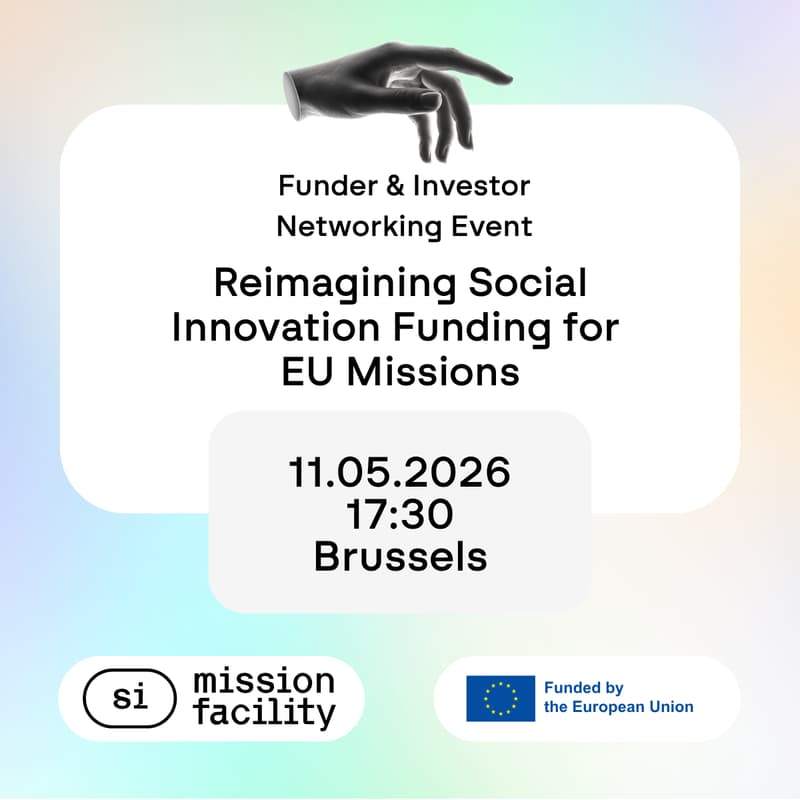
The Funder & investor networking event “Reimagining Social Innovation Funding for EU Missions” organised by our partners EdelGive/SIX took place on 11 May in Brussels, featuring a strong panel (read the full post here).
Secondly, our first in-person workshop took place on 12 May in Brussels, organised by DRIFT, where the SIMF presented impact pathways of the 280 projects funded by the Missions. We further hat a panel discussion on future opportunities and challenges and as a highlight: an interactive session with the possibility to work in smaller groups on implementation mechanisms.
Ongoing activities
We have launched initial steps of our Training and Scaling Lab programme, and are developing tools to support funders, practitioners, and ecosystem actors in scaling social innovation more effectively across Europe.
The online capacity building webinars will run until June 2026, while the in person bootcamp in Bucharest, Romania, will take place in September 2026.
There will be an upcoming open call in June for the “Training and Scaling Facility”, addressing social innovators that wish to improve their skills in mission-oriented support. We will communicate the open call soon, make sure to spread the word to your network!
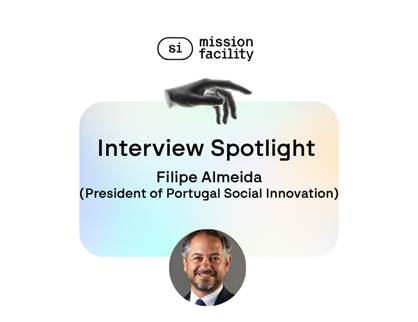
Filipe shared insights into his views on recent policy developments concerning SI and Missions. Filipe Almeida demonstrated how a coordinated, government-led approach can catalyse an entire ecosystem. Yet, as Filipe Almeida highlights, the real challenge lies not in generating innovative ideas, but in embedding them into systems. For the next EU funding cycle, the question is no longer whether to support social innovation, but how to ensure it drives lasting structural change.
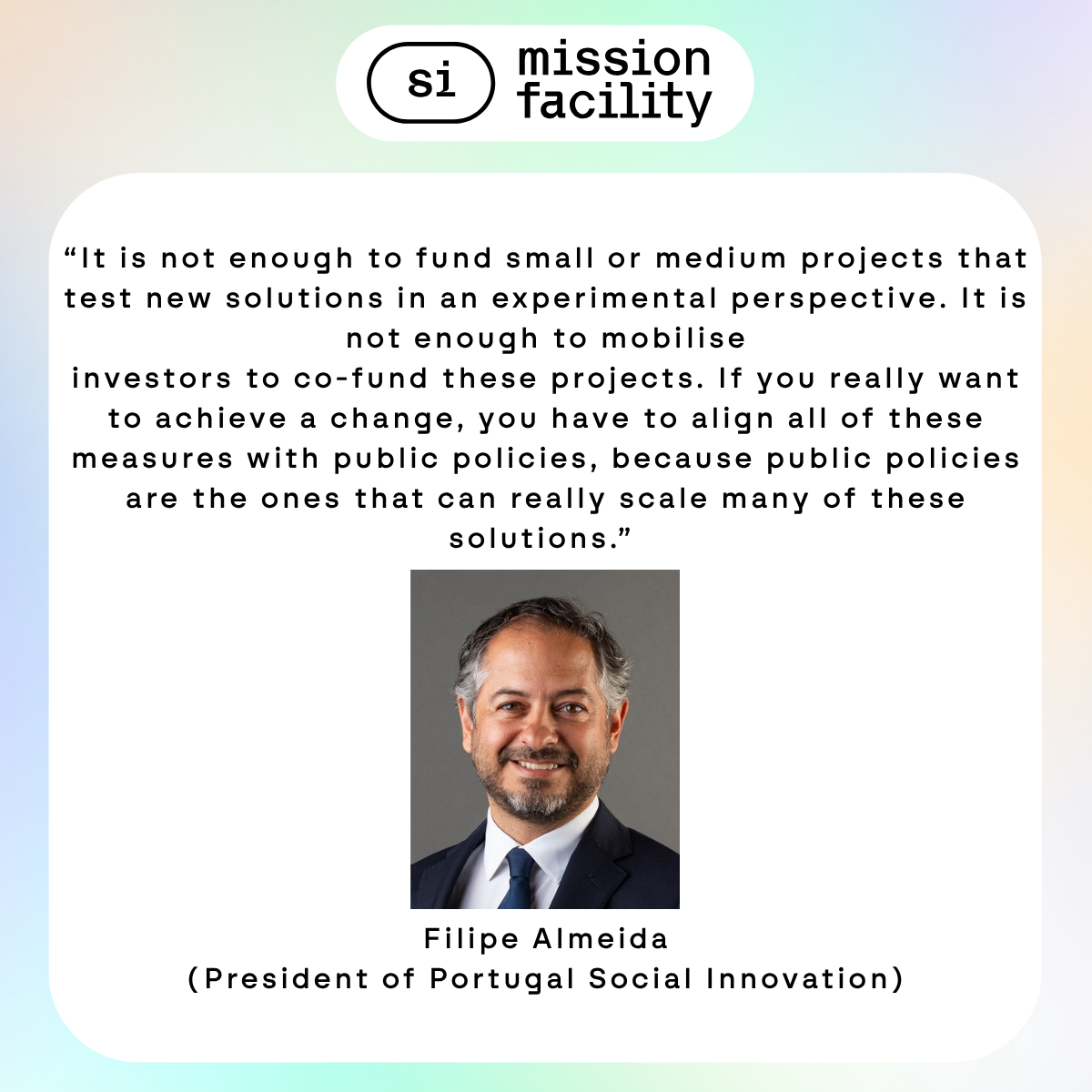
“It is not enough to fund small or medium projects that test new solutions in an experimental perspective. It is not enough to mobilise investors to co-fund these projects. If you really want to achieve a change, you have to align all of these measures with public policies, because public policies are the ones that can really scale many of these solutions.” – Filipe Almeida
Stay tuned for the following activities by the SIMF!
🗓️We encourage you to take a closer look into our curated SIMF calendar, featuring events organised by the SIMF and events organised by our ‘external’ social innovation and Mission ecosystems.
We are building a growing European ecosystem that connects social innovation, policy, and investment to accelerate mission-driven impact. With strong partners, emerging tools, and first key outputs, SIMF is already taking important steps toward making social innovation a core force in Europe’s transformation journey.
Thank you for being part of our journey and mission(s)!
https://staging.simissionfacility.eu/wp-content/uploads/2026/05/Copy-of-SIMF-Social-Media-Postings-111.png12001200Leonie Dworskyhttps://staging.simissionfacility.eu/wp-content/uploads/2025/09/SIMF-BASICS-LOGO-V1-RGB_SIMF-BASICS-LOGO-V1-POS-RGB.svgLeonie Dworsky2026-05-28 17:58:472026-05-28 17:58:47Our first newsletter is here!
Social Innovation at Stake? A talk with Filipe Almeida.
Introducing Filipe Almeida
Filipe Almeida is the President of Portugal Social Innovation, which is the national public policy initiative dedicated to social innovation within the Portuguese government.
Portugal Social Innovation was established to both promote social innovation and develop a robust social investment ecosystem. We primarily use European Structural Funds – currently the European Social Fund Plus – to finance innovative projects addressing pressing societal challenges. A key feature of our model is that we match public funding with social investment, fostering cross-sector collaboration and building new alliances across stakeholders.
Over time, Portugal Social Innovation has become a central hub within the national ecosystem, connecting social entrepreneurs, investors, public authorities, academia, and civil society organisations. It is not only a funding mechanism, but also a coordinating platform embedded at the core of government, with a clear mandate to drive systemic change.
How does your work connect to social innovation?
Portugal Social Innovation was created in 2014 as a pioneering, government-led initiative. From the outset, it played a catalytic role in shaping the national social innovation ecosystem.
Our work connects to social innovation (SI) in three fundamental ways:
First, we experiment with financial instruments and support projects that test new solutions to social challenges across sectors.
Moreover, we are building bridges and actively facilitate collaboration and co-creation between investors and different forms of organisations.
And thirdly, as a public agency, we further ensure that promising solutions are connected to public administration, enabling pathways to scale through policy integration.
Specifically, the last point is crucial. We believe that social innovation cannot remain at the level of isolated experimentation and if we want real transformation, solutions must be embedded into public policies, which remain the most effective vehicle for scaling impact.
What added value does social innovation bring to mission-oriented policy and to addressing major societal challenges?
Mission-oriented policies aim to tackle complex, systemic challenges such as climate change, inequalities, or public health. Traditionally, these policies rely on top-down, technical approaches. Social innovation adds a fundamentally different dimension to this.
It introduces a bottom-up, human-centred, and systemic perspective, with several key contributions:
Social innovation enables active participation, as it brings citizens, communities, and grassroots actors into the design and implementation of solutions.
Through active participation, solutions can be better aligned with real needs as solutions are shaped by those directly affected, making them more relevant and effective.
Mission-oriented initiatives become more effective when people affected by the problem are actively involved in shaping solutions. Trust can be built through the participation and empowerment of the people affected, and stronger relationships between institutions and communities can result from participatory processes.
With this understanding social innovation encourages tailored, context-specific solutions rather than one-size-fits-all approaches and thus also entails a preventive element as root causes can be addressed rather than merely compensating for symptoms.
Ultimately, SI can also bring together actors from different sectors to co-create solutions.
In essence, social innovation enriches mission-oriented policy by making it more inclusive, adaptive, and transformative.
Why does social innovation still struggle to receive adequate policy attention and funding support?
There are several structural and conceptual barriers.
First, social innovation remains misunderstood. It is often conflated with traditional social policy focused on compensation rather than transformation. This limits its perceived scope and ambition.
Second, it does not fit into existing policy silos. Social innovation is inherently cross-sectoral, while public administration, and EU funding structures, are still largely compartmentalised.
Third, technological innovation continues to dominate the narrative. Innovation is still widely equated with technology, whereas social innovation is often seen as secondary, despite being an end in itself.
In addition, with regards to funding challenges, impact of social innovations is difficult to measure, making it riskier for funders and policymakers. In alignment with the rather fragmented ecosystem, advocacy remains weak, with actors often operating within their own “bubble.” These combined factors prevent social innovation from becoming mainstream in policy and funding frameworks.
What are the current gaps in funding or support for social innovation on EU level?
In my perspective, several gaps in funding support persist on EU level:
There is a fragmented funding landscape, and social innovation is spread across multiple programmes, limiting coherence and visibility. Especially the reliance on ESF+ funding ties social innovation primarily to employment and social inclusion, leaving areas like climate, digitalisation, and community resilience underexplored.
EU level support for social innovation is currently paired with heavy administrative burden. Small organisations and startups often lack the capacity to navigate complex funding requirements. In addition, while experimentation is funded (usually in the form of new projects developed), there are few mechanisms to support the scaling of successful solutions, especially through public policy integration and programmes rarely assess how projects influence public policy evolution.
Lastly, match-funding mechanisms on EU level remain underexplored and there are limited instruments that effectively combine public funds with private or social investment.
Addressing these gaps is essential to move from isolated innovation to systemic change.
How should social innovation be reflected in the next EU Multiannual Financial Framework (MFF 2028–2034)?
A major step forward has already been taken in 2014 by requiring all Member States to include social innovation as an investment priority. This should not only be maintained but strengthened.
Looking ahead, several improvements are needed from Filipe Almeida’s perspective:
Maintain mandatory inclusion of social innovation: Removing this requirement would be a step backwards.
Increase visibility: Introduce clearly labelled budget lines for social innovation, rather than dispersing funding across programmes.
Improve coordination: Avoid fragmentation across regions and instruments.
Simplify access: Introduce micro-grants and fast-track funding for smaller organisations.
Support different development stages: Create multi-stage funding pathways from early experimentation to mature scaling.
Promote blended finance: Combine grants with instruments such as social impact bonds and equity-based funding.
Fund organisations, not just projects: Provide core funding to strengthen organisational capacity and resilience.
Strengthen impact measurement: impact evaluation enables comparability across projects.
Invest in capacity building: Support not only innovators but also public authorities, academia, investors, and media.
These changes would significantly enhance the effectiveness and reach of social innovation in Europe.
What concrete changes would you like to see in future EU programmes and policy instruments?
If we want social innovation to truly deliver systemic impact, EU programmes should shift from funding experimentation alone to funding scaling pathways, particularly through public policy integration.
To achieve this, cross-sector alignment should be strengthened and silos between social, environmental, and economic policy areas should be broken down.
EU programmes must also reduce administrative complexity, which is especially relevant for smaller actors. Strengthening blended finance and match-funding models and leveraging private capital is another recommendation which could also potentially help with reducing administrative complexity.
Impact measurement also needs to become more systematic. At the same time, organisations need support to build the capacities required to measure and communicate impact effectively.
Ultimately, Filipe stresses that the goal should be to move from a fragmented ecosystem of projects to a coherent system where social innovation informs and transforms public policy at scale.
Portugal Social Innovation demonstrates how a coordinated, government-led approach can catalyse an entire ecosystem. Yet, as Filipe Almeida highlights, the real challenge lies not in generating innovative ideas, but in embedding them into systems. For the next EU funding cycle, the question is no longer whether to support social innovation, but how to ensure it drives lasting structural change.
https://staging.simissionfacility.eu/wp-content/uploads/2025/09/SIMF-BASICS-LOGO-V1-RGB_SIMF-BASICS-LOGO-V1-POS-RGB.svg00Leonie Dworskyhttps://staging.simissionfacility.eu/wp-content/uploads/2025/09/SIMF-BASICS-LOGO-V1-RGB_SIMF-BASICS-LOGO-V1-POS-RGB.svgLeonie Dworsky2026-05-27 19:04:492026-06-26 09:59:23Social Innovation at Stake? A talk with Filipe Almeida.
The Social Innovation Mission Facility successfully kicked-of the 𝗧𝗿𝗮𝗶𝗻𝗶𝗻𝗴 𝗮𝗻𝗱 𝗦𝗰𝗮𝗹𝗶𝗻𝗴 𝗟𝗮𝗯 𝗣𝗿𝗼𝗴𝗿𝗮𝗺𝗺𝗲 𝗳𝗼𝗿 𝗕𝘂𝘀𝗶𝗻𝗲𝘀𝘀 𝗦𝘂𝗽𝗽𝗼𝗿𝘁 𝗢𝗿𝗴𝗮𝗻𝗶𝘀𝗮𝘁𝗶𝗼𝗻𝘀 𝗮𝗻𝗱 𝗦𝗼𝗰𝗶𝗮𝗹 𝗜𝗻𝗻𝗼𝘃𝗮𝘁𝗶𝗼𝗻 𝗦𝘂𝗽𝗽𝗼𝗿𝘁 𝗢𝗿𝗴𝗮𝗻𝗶𝘀𝗮𝘁𝗶𝗼𝗻𝘀 (𝗕𝗦𝗢/𝗦𝗜𝗦𝗢) on May 5 with the first webinar, organised by the Impact Hub Network (Lucia Radu).
Supporting mission-oriented innovators is not straightforward work. It requires systems thinking, strategic selection, intentional programme design – 𝗮𝗻𝗱 𝗮 𝗰𝗼𝗺𝗺𝘂𝗻𝗶𝘁𝘆 𝗼𝗳 𝗽𝗲𝗲𝗿𝘀 𝘄𝗶𝗹𝗹𝗶𝗻𝗴 𝘁𝗼 𝗰𝗼𝗹𝗹𝗮𝗯𝗼𝗿𝗮𝘁𝗲 𝗼𝗻 𝘀𝘆𝘀𝘁𝗲𝗺𝗶𝗰 𝗰𝗵𝗮𝗹𝗹𝗲𝗻𝗴𝗲𝘀.
This kickoff session introduced the toolkit that anchors the programme and opened with a case study on mission-aligned network growth from Impact Hub. The webinar further gave participants the first opportunity to connect across the cohort.
Reimagining Social Innovation Funding for EU Missions
Join leading funders and investors from across Europe for a convening hosted by the Social Innovation Mission Facility with partners, The Commons Hub and Strategic Design Scenarios – bringing together key actors to explore how private and public capital can be catalytically combined to drive mission-oriented social innovation at scale.
We will have a dynamic panel discussion featuring voices from across Europe, examining:
The trends and emerging models of financing social innovation already shaping the field
How to increase flow of capital into EU Mission-aligned social innovation
How philanthropic, public, and private capital can be combined for greater impact
The role of investors and funders in shaping Europe’s social innovation ecosystem
Our aim is to create a space for honest dialogue, peer-to-peer connection, and forward-looking exchange.
Expect an energising atmosphere, plenty of room for conversation, and the chance to hear perspectives from across the field. Whether you’re already supporting the EU Missions or are curious about the future of social innovation funding, this is a chance to connect and leave with new ideas to take forward.
Speakers
The panel discussion will be moderated by Carly Wickham, EdelGive/SIX.
Amir Rizwan – London Social Ventures (UK)
Amir Rizwan is the outgoing Director of London Social Ventures and an independent impact investment consultant. He works with foundations and investors on strategy, governance, and how capital can be deployed to support early-stage ventures and inclusive economic growth. His work sits at the intersection of social innovation, investment, and ecosystem development, with a focus on how new venture models can address complex societal challenges. He has worked across the UK social investment ecosystem, including roles at Better Society Capital and Comic Relief, where he led the development of its social investment strategy, including the £7.5m Red Shed Fund. Amir holds board and investment committee roles with Social Investment Scotland and The Clothworkers’ Foundation and is a trustee of the Joseph Rowntree Foundation. His work focuses on aligning investment approaches with mission, strengthening venture pathways, and addressing structural inequalities in access to capital.
Anne Snick – Club of Rome (EU Chapter)
Anne Snick is a systems thinker, philosopher, and independent researcher whose work sits at the intersection of sustainable finance, social innovation, and regenerative economics. She holds a PhD in Philosophy of Education, with a focus on ethics and epistemology, and has spent her career alternating between academic research and applied work in health, gender equality, social economy, and social innovation. Anne is a full member and Board member of the Club of Rome’s EU Chapter, and serves as an Ethics Expert in Research and Innovation for the European Commission. Her current work focuses on how finance and education — as two of the most powerful systemic drivers in society — can be redirected towards ecological and social sustainability. Anne brings a distinctive systems-level lens to questions of social innovation finance, arguing that social and environmental sustainability are fundamentally inseparable, and that meaningful change requires paradigm-level shifts in how we understand the purpose of money and capital.
Luisa Bernardes – Portugal Social Innovation
Luísa Bernardes is the Centro Region Representative and International Projects Manager at Portugal Social Innovation, with five years in the technical financing team and a background in the Simplification and Interconnection Unit of the Portuguese Agency for Cohesion and Development, where she served as Portugal’s EaSI National Contact Point and contributed to establishing National Competence Centres for Social Innovation. She draws on nearly two decades of experience in European and international partnerships – 13 years leading the Cooperation and International Relations Department at the Chamber of Commerce and Industry of Portugal’s Centro Region – and has been a longstanding member of the Enterprise Europe Network. She is also the founder of Mulheres Incomuns, a community dedicated to celebrating women’s success.
Pieter-Jan Van de Velde – Trividend
Pieter-Jan Van de Velde is a key figure in Belgium’s impact investing ecosystem, specializing in early-stage financing for social economy enterprises. As Investment and Fund Manager at Trividend, he transformed it into the leading early-stage investor in impact ventures in Flanders, managing over 50 direct investments, including subordinated and convertible loans as well as equity participations. He is also founding partner of the European Catalytic Impact Investing Fund ECIIF II. Pieter-Jan is committed to building impact financing ecosystems that offer an adequate financing mix to each impact venture to achieve its full potential. His expertise spans investment strategy, financial structuring, governance models and scaling mission-driven enterprises.
Event details
Date: 11 May, 2026 Time: 17.30 – 20.30 Location: Brussels near Central Station (Exact location available once registered)
Arrival from 17.30 Talk/discussion begins at 18.00
Register Your Interest
Whether you are a philanthropist, impact investor, or public funder, this is an opportunity to connect, collaborate, and help shape the next chapter of social innovation in Europe.
Places are limited and will be confirmed directly. We encourage early registration, here: https://luma.com/hudbvsbh
The EU Missions are tackling urgent challenges like climate change, biodiversity loss, and ocean pollution, driving systemic change toward sustainability. But achieving their goals requires more than technology—it demands social innovation to address societal needs in new ways. 𝐁𝐮𝐭 𝐡𝐨𝐰 𝐜𝐚𝐧 𝐬𝐨𝐜𝐢𝐚𝐥 𝐢𝐧𝐧𝐨𝐯𝐚𝐭𝐢𝐨𝐧 𝐛𝐞 𝐦𝐨𝐫𝐞 𝐞𝐟𝐟𝐞𝐜𝐭𝐢𝐯𝐞𝐥𝐲 𝐦𝐨𝐛𝐢𝐥𝐢𝐬𝐞𝐝 𝐭𝐨 𝐚𝐜𝐜𝐞𝐥𝐞𝐫𝐚𝐭𝐞 𝐭𝐡𝐞 𝐢𝐦𝐩𝐥𝐞𝐦𝐞𝐧𝐭𝐚𝐭𝐢𝐨𝐧 𝐨𝐟 𝐭𝐡𝐞 𝐌𝐢𝐬𝐬𝐢𝐨𝐧𝐬?
Based on an analysis of 280 Mission-funded projects, we’ll share key insights on how social innovation is currently addressed across the five Missions. The session includes an expert panel and group discussions to 𝐞𝐱𝐩𝐥𝐨𝐫𝐞 𝐡𝐨𝐰 𝐭𝐨 𝐛𝐞𝐭𝐭𝐞𝐫 𝐞𝐦𝐛𝐞𝐝 𝐬𝐨𝐜𝐢𝐚𝐥 𝐢𝐧𝐧𝐨𝐯𝐚𝐭𝐢𝐨𝐧 𝐢𝐧 𝐌𝐢𝐬𝐬𝐢𝐨𝐧 𝐩𝐨𝐫𝐭𝐟𝐨𝐥𝐢𝐨𝐬. Together, we’ll co-develop actionable starting points to strengthen its integration.
🗓️ Tuesday, 12 May 2026 12:30 – 16:00 CEST
📍 Brussels
For:
▪️ Policy actors shaping and implementing the EU Missions;
▪️ Researchers and practitioners advising on or contributing to Mission implementation.
This is an invitation-based workshop, with a number of places available for eligible participants. To participate, please register via this link: https://forms.gle/5vkVnk4q89sFjQ7F6
https://staging.simissionfacility.eu/wp-content/uploads/2026/03/WS_12052026_website.png500616Leonie Dworskyhttps://staging.simissionfacility.eu/wp-content/uploads/2025/09/SIMF-BASICS-LOGO-V1-RGB_SIMF-BASICS-LOGO-V1-POS-RGB.svgLeonie Dworsky2026-03-12 15:53:422026-04-24 10:39:55Upcoming Workshop: “Embedding Social Innovation in EU Missions”
To provide the best experiences, we use technologies like cookies to store and/or access device information. Consenting to these technologies will allow us to process data such as browsing behavior or unique IDs on this site. Not consenting or withdrawing consent, may adversely affect certain features and functions.
Functional
Always active
The technical storage or access is strictly necessary for the legitimate purpose of enabling the use of a specific service explicitly requested by the subscriber or user, or for the sole purpose of carrying out the transmission of a communication over an electronic communications network.
Preferences
The technical storage or access is necessary for the legitimate purpose of storing preferences that are not requested by the subscriber or user.
Statistics
The technical storage or access that is used exclusively for statistical purposes.The technical storage or access that is used exclusively for anonymous statistical purposes. Without a subpoena, voluntary compliance on the part of your Internet Service Provider, or additional records from a third party, information stored or retrieved for this purpose alone cannot usually be used to identify you.
Marketing
The technical storage or access is required to create user profiles to send advertising, or to track the user on a website or across several websites for similar marketing purposes.